An automatic reaction saves a second of reflection and can cost you hours of misunderstanding.
Imagine you have the same meeting every Monday at ten. And every Monday, the same colleague interrupts you. Sara has had him labelled “arrogant” for two years. By ten past ten she is already telling him off in her head, and she misses the rest of the meeting.
The next Monday it happens again, and it costs her another hour.
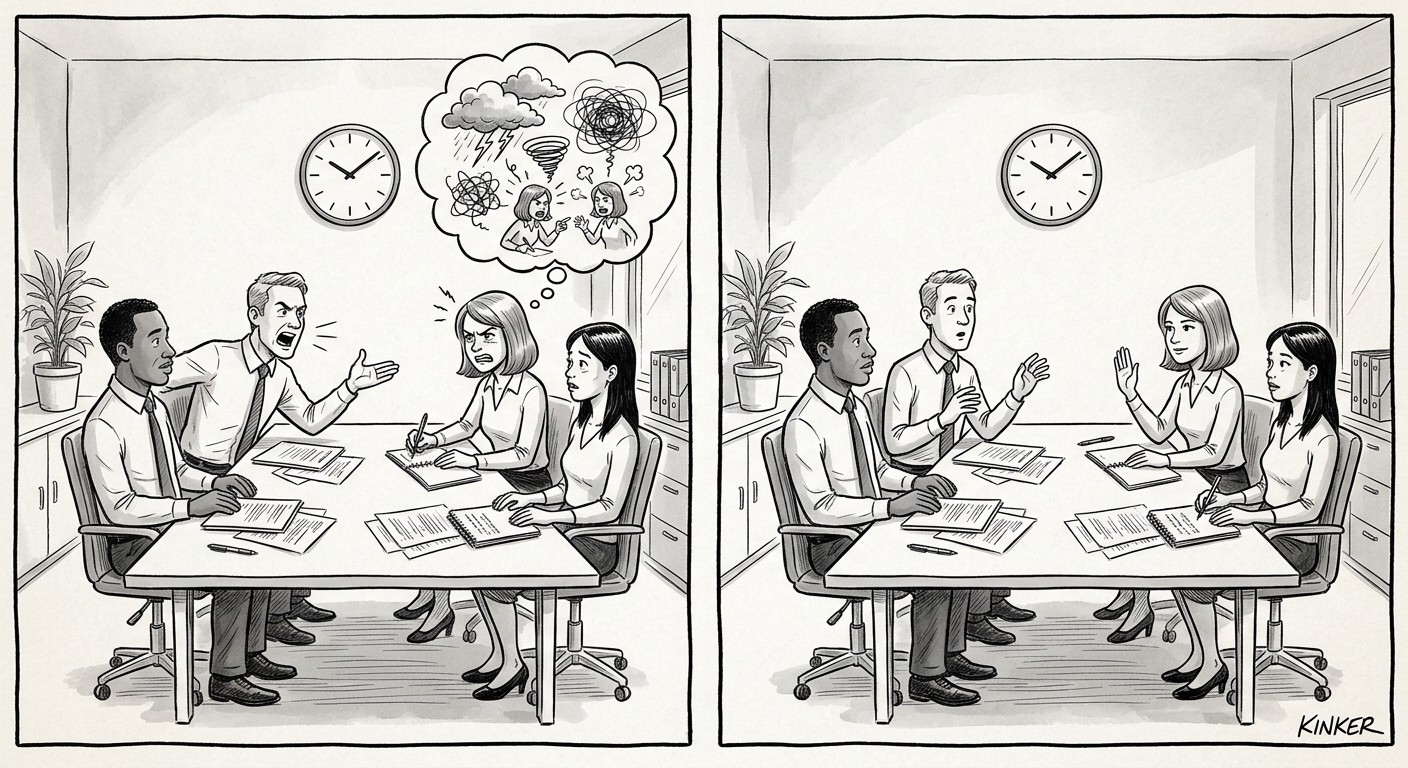
Illustration: AI-generated
A reaction has two moments. First, the trigger: the fact, real or perceived, happening now. Second, the interpretation: the lens that fact passes through. That lens is made of assumptions, demands and old labels that formed once and were almost never revisited. And it is the lens, more than the fact, that decides how much charge the trigger carries.
The trigger is fast and involuntary, and often not yours to change. The interpretation you built yourself, so you can edit it. With the same trigger and a different interpretation, the reaction is completely different.
Left unchecked, the pattern accumulates. Sara pays for the same reaction every week, and each time she adds a little more “evidence” to the label. Here are four ways to clean the lens.
1. Decide in advance. If you know a certain meeting drives you up the wall, don’t wait for the heat of the moment. Choose beforehand: “when he interrupts, I’ll jot down my idea and pick it up when he’s done.” Or, with all the calm in the world: “Let me close this point and I’ll hear you better right after.” The initial reaction is still there, but you’ve already chosen which version of you arrives first.
2. Ask whose demand it is. Often the lens carries a hidden “should”. For example, you tell yourself: “By now I should be further along.” Sara, without realising it, may be carrying another: “nobody should interrupt.” Before obeying it, ask whose idea that is, whether it’s still relevant, and whether it reflects your values today, or whether you borrowed it from somewhere and never gave it back.
3. Check your labels about others. A label saves energy the day it’s applied, and the cost comes later, when it no longer fits. Maybe it never did. Sara’s colleague may be arrogant. He may also be anxious, or hard of hearing, or come from a team where interrupting was a sign of enthusiasm. She has gone two years without asking.
4. Choose being effective over being right. Sometimes you are right, and what happened really was unfair. Being right is a fact about what already happened. Being effective is a decision about what happens next, and the two don’t always point the same way. A useful question: am I still gathering information, or am I repeating the verdict?
The ten-second version. For everyday use, three questions:
- What have I just confirmed?
- Would I demand this of someone else? Would I want it demanded of me?
- If it’s true, does it matter for what I’m about to do?
In Tired of Being Tired we talked about the fifth state, rest and repair. Sara, angry, rehearsing her reply in her head at ten past ten, was far from it. What is the difference when people are in a state of calm (rest and repair) rather than on alert?

Simply, they have all their capacities at hand. Of course they get provoked too, just like anyone, but their lens is clean: they see beyond the fact, interpret less and act more. They live in the present. Every time you spot an unquestioned assumption, you are cleaning your lens.
What label have you stopped checking?
Think of someone you labelled with a single word long ago. What would fresh eyes notice today? If you’d like me alongside you in that review, bring it to a clarity session.
This story is fictional.