Tired people make a lot of decisions. Rested people make a few important ones and let their values and priorities take care of the rest.
Four ways the body responds to pressure
When something feels like a threat, your nervous system sounds an alarm, and your body responds in one of four ways:
Freeze. The brakes slam on while the accelerator is still floored. It’s often mistaken for indifference, but someone who freezes feels trapped.
Fight. The energy goes outward, into confrontation. It’s almost always defending a need that doesn’t have a name yet.
Flight. There’s nowhere to run in an office, so the energy leaks out as restlessness: scrolling your phone, going round in circles, staying busy.
Fawn. From the outside it looks like calm, but the alarm is still ringing inside. The body chooses to keep the peace in order to stay safe.
None of these is who you are. They’re what a nervous system does under pressure.
There is a fifth state, the one we are aiming for: rest and repair. Here the alarm is off, and the body can digest, heal and recover.
An ordinary Tuesday
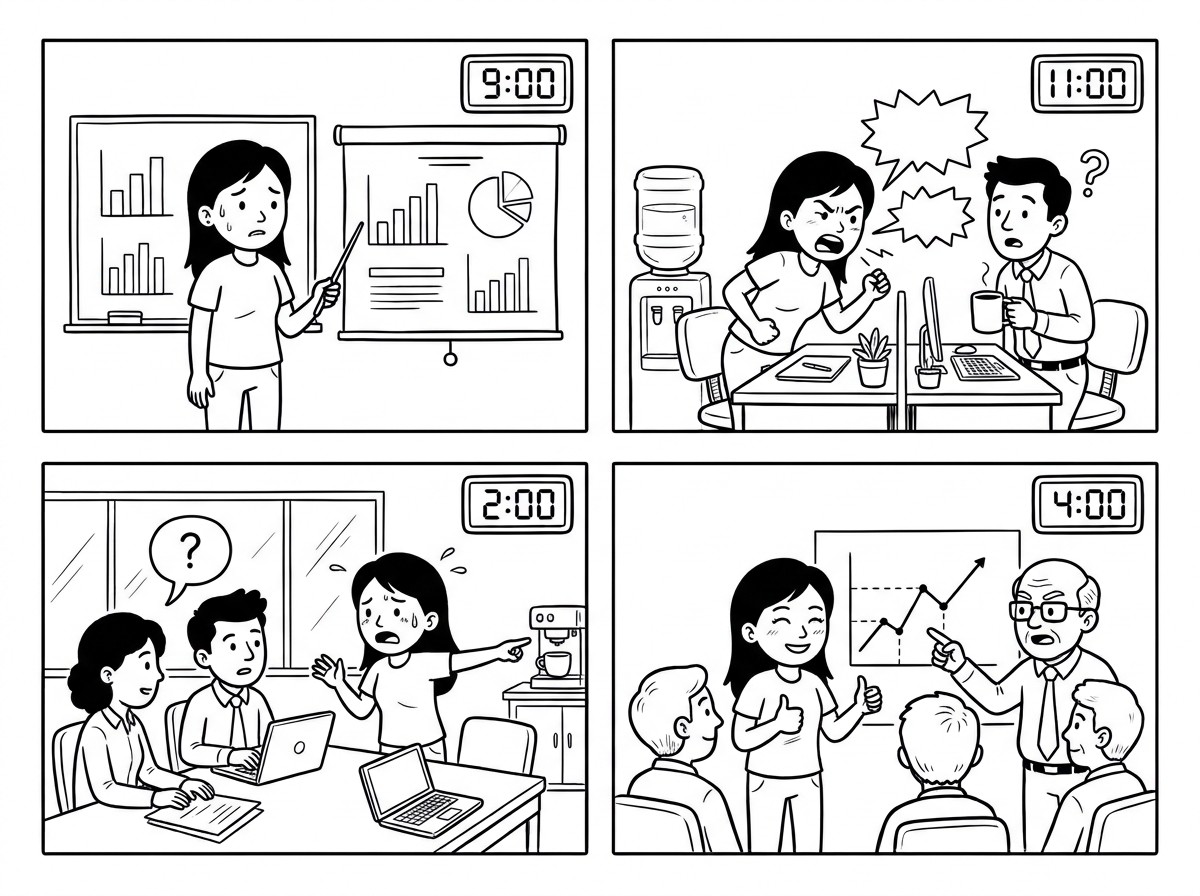
Illustration: AI-generated
At nine, your boss calls in sick and you’re told to give her presentation, right now. Your mind goes blank: freeze. At eleven, a rumor of layoffs goes around and you snap at a colleague: fight. What you were defending was a bit of certainty about the future. At two, someone asks a question you can’t answer and you change the subject: flight. At four, a more senior colleague contradicts you in front of the team, and you hear yourself agreeing: fawn.
By six, you’ve got very little done and you’re exhausted.
Why sleep doesn’t fix this kind of tired
Each of these responses keeps your body on alert, and a body on alert burns energy all day. It struggles to fall asleep, and it reads neutral facts as threats, which sets off the next alarm.
Sometimes we do sleep, but only because exhaustion finally overpowers the alarm. That is collapse, not rest. Real rest only happens when the body has left all four responses and moved into rest and repair.
It also makes worse decisions. We make far more decisions each day than we realise, and the ones we don’t notice cost us. When you’re on alert, you have to decide everything from scratch, because the alarm overrides your plan and any resolutions you’ve made.
A tool to lower the alarm: NBN
I call it NBN: nose, belly, nose.
Breathe in through your nose and let the air sink low until your belly expands. This is diaphragmatic breathing, also known as belly breathing. Breathe out slowly through your nose, a little longer than you breathed in. Counting four in and six out works for almost everyone. A long exhale is one of the few direct ways we have of telling the body it’s safe to move into rest and repair.
Breathing won’t resolve the layoff rumor. It gives you a calmer place to think from, and from there you can ask the useful question: which of the four was that, and what was it protecting?
What sets off your alarm, and what calms it?
Name one place, activity or person that drains you. Notice which of the four responses shows up most in that situation. Then ask yourself: what is setting off the alarm?
Now name one place, activity or person that calms you. What is it about them that lets your body relax? Once you know, you can build more of it into your week.
To get to the root of what sets off your alarm, and where that belief comes from, read New Space, Same Reactions.
If you’d like to look at your own Tuesday with someone, that’s what a clarity session is for.
The four responses appear in many models of stress. The layers come from Stephen Porges’s polyvagal theory, which I use as a working image rather than settled science. This Tuesday is made up of many real days.