For centuries Europeans knew that all swans were white. Then someone sailed to Australia.
An old Chinese story tells of a man who loses his axe and suspects his neighbour’s son. He watches the boy. The boy walks like a thief, looks like a thief, talks like a thief.
Then the man finds the axe in his own garden. The next day the boy walks, looks and talks like any other boy.
Nothing about the boy had changed.
In medieval Europe, swans were white by definition. Bestiaries, the illustrated books of animals, describe their snow-white feathers, and the word “swan-white” appears in English by 1393, used by the poet William Langland. “A black swan” was a way of saying “something impossible”. In 1697 Dutch sailors reached Western Australia and saw black swans on the river.
The centuries of white swans had never proved the rule. They had only failed to contradict it, and it took a single black swan to end it. This is roughly how careful science works, as the philosopher Karl Popper argued: you look for the observation that could knock your idea down, because collecting more examples that agree with it tells you very little.
We rarely treat our own beliefs that way. “I’m not a numbers person.” “She doesn’t respect me.” “I always freeze in meetings.” Once a belief is in place, we notice what fits and walk past what doesn’t. Like the man with the axe, we see a thief because we expected to see one.
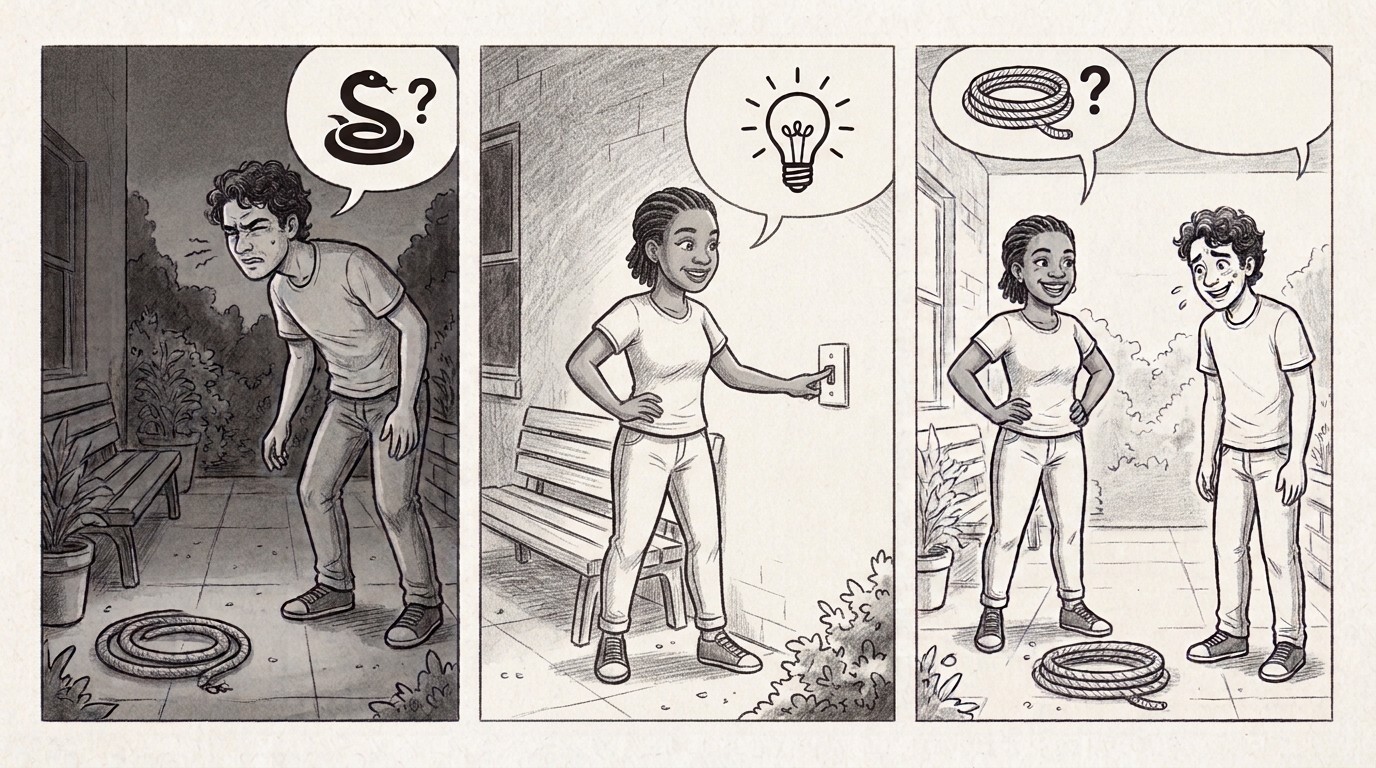
Illustration: AI-generated
Those drawings that hold two pictures at once make the same point: the duck that is also a rabbit, the vase that is also two faces. Most people see one picture first and need a moment to find the other. Look for long enough and you may notice that you cannot quite see both at the same time. To see the second, you have to let go of the first for a moment.
So I suggest a short check for the moments when a reaction turns up fast and certain.
- What did I expect to see?
- Is this the first thing I see, or the only thing?
- What holds this belief up: evidence, habit, or someone else’s voice?
- What would a black swan look like here? One fact that doesn’t fit.
- Add a tagline: “…or perhaps ______.”
That last step is the one people remember. “He ignored my message, or perhaps he hasn’t seen it.” “I’m bad at this, or perhaps I’ve only tried it one way.” The tagline doesn’t claim the first reading is wrong. It leaves room for a second one.
I sometimes describe it as updating old software. When a program gives an unexpected result, a good engineer goes looking for the bug and learns something from it. You can treat a belief the same way.
Who is your neighbour’s son?
Think of one person, or one belief about yourself, that you have only seen at first glance. Look for one black swan this week. If you would like a second pair of eyes, bring it to a clarity session.
The axe story is from the Liezi. Medieval bestiaries describe the swan as white; the earliest record of “swan-white” is from William Langland, 1393 (Oxford English Dictionary). Karl Popper used the black swan to explain how science tests ideas. The sighting is recorded from Willem de Vlamingh’s 1697 expedition.