Her brushes were dirty and she didn’t want to wash them. So she used her fingers.
Taiwan, 2010. American painter Iris Scott is about to finish a canvas. Her brushes are stained and she can’t be bothered to clean them. She picks up the paint with her fingers and finishes the painting. She never picked up a brush again.
Curiously, as a child she hated finger painting. Today it is her signature: she paints with surgical gloves, straight from her hands.
The answer had been at the end of her arm all along. She had simply thought of her hands as the thing that holds the brush.
Psychologists call it functional fixedness: we see an object only for its usual purpose. In a classic experiment by Karl Duncker, participants were given a candle, a box of tacks and some matches, and asked to fix the candle to the wall so the wax wouldn’t drip onto the table. Many struggled, because they saw the box only as a container for the tacks. Emptied and pinned to the wall, it becomes a shelf.

We do the same with ourselves. A skill is “just for work”. A trait we were corrected for is “a weakness”. An ability we used in another country, another decade or another role gets filed under “that was back then”.
We also have habits that make us smaller than we are. These are the three I hear most:
“It was just luck.” We explain a good result as something outside ourselves.
“They’ll realise they made a mistake choosing me.” We treat our competence as a costume: we’re impostors.
“I don’t even notice.” The mind gets used to registering only what went wrong, and lets what went well slip by.
How do you face a new situation? It can feel like a threat and seem bigger than we are. To manage it, you can discover that the situation is smaller than it looked, or that it can be broken into manageable problems. And there is a third option, the one that interests me most: realising that you are bigger than you thought. Bigger doesn’t mean louder or more rigid. It means more capable, with more experience and more resources than you realise you have.
Two tools help.
1. Notice your wins. Every night, write down three things you solved. Next to each one, note who got the credit. Then rewrite one, giving the credit to yourself.
2. The Duncker shift. Pick something you use in only one way (a skill, a trait or even a routine) and ask yourself how else it could be used. For example, the project management you’ve mastered at the office can come home to plan your family holiday. Sensitivity, filed away as a weakness, is the ability that lets you notice when someone in the group is having a hard time. And your walk to work, long and boring, can become a mindfulness exercise.
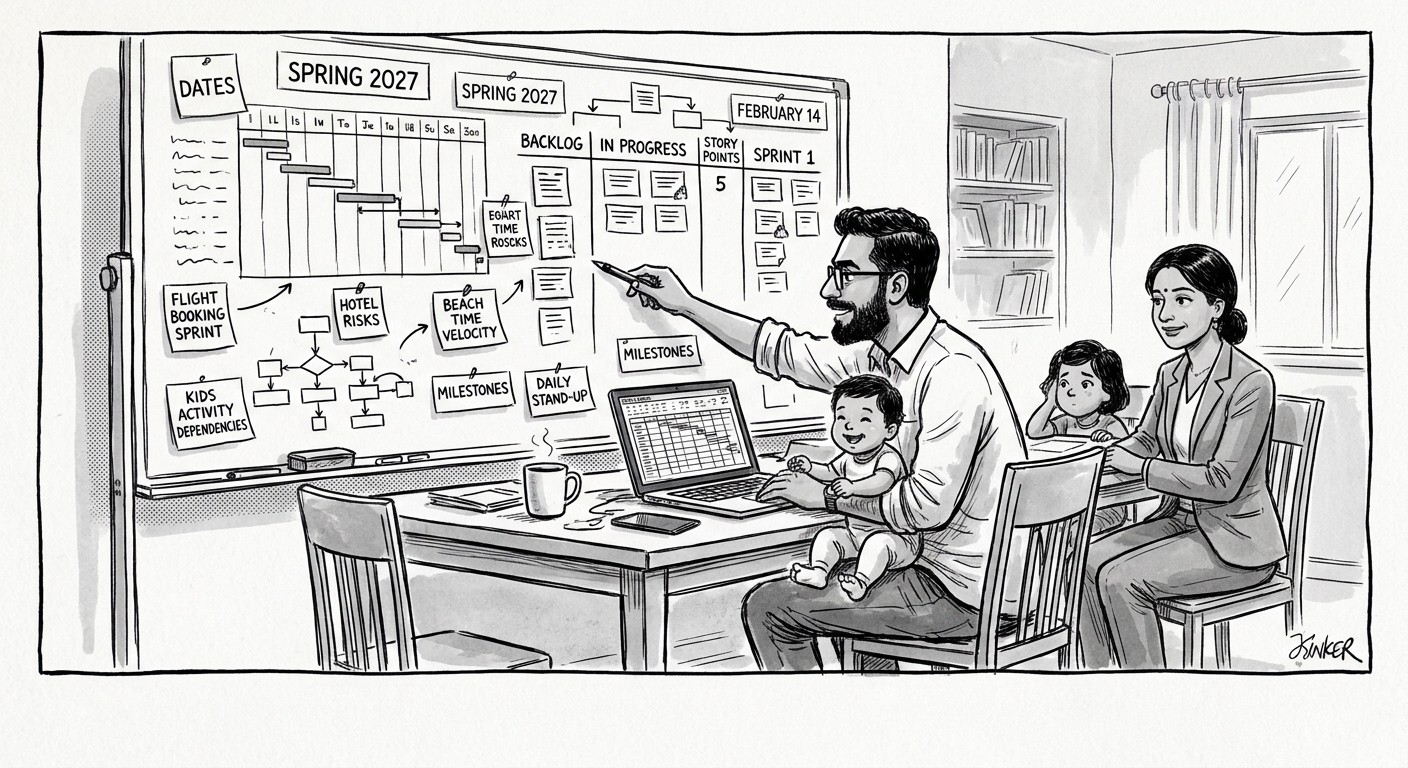
Illustration: AI-generated
Use one of your skills “out of context” once this week, on purpose, without waiting for anyone’s permission. And see what happens.
What have you stopped using?
Make a list of what you have: your skills, your experience, the people around you, your voice. Circle one you’ve set aside. If you’d like company while you take stock, let’s meet in a clarity session.
Sources: Karl Duncker (1945) on functional fixedness; Iris Scott’s interview with artnet News (Sarah Cascone).