When a problem keeps going round in your head, put it on one page.
Laura has been “too busy” for two years. Ask her why and she has excellent explanations: the restructure, her manager, the school run, the season. Each one is true. None of them has changed anything.
So we try something else. A sheet of paper, one phrase in the middle, “Too busy”, and four branches. On each branch she writes one real example. No reasons.
I use mind maps in almost all my group work, and with individual clients when a subject has become a loop. A list keeps you inside the story, one thing after another, in the order you always tell it. A map puts everything on the table at once, so you can stand back and see it.
Here is how I set one up.
One thing in the centre. Write a phrase, and avoid a question. “Too busy.” “The argument about money.” “My mother’s calls.”
Four branches. More than four becomes another list. For Laura: what I stopped doing, who noticed, what it cost, what I got to keep.
One or two real examples on each. This is the rule that does the work: facts, not explanations. What happened, when, and who noticed. “I missed Maya’s recital on 14 March” is a fact. “Work was impossible that month” is an explanation. Explanations are where we defend ourselves. Facts are simply there on the page.
Then read the facts again. Once the facts are written down, the next layer is what you made of them: your interpretation. Look at each one and ask: is there another possible explanation? Is a detail missing? “I missed Maya’s recital” can quickly become “I am a bad mother”. It could also mean “I agreed to a deadline nobody questioned”, or “I never told anyone the recital mattered to me”. The fact stays the same. The interpretation is where there is room to move.
Stand back. Literally. Put the page on the table and look at it from a step away. What repeats? Where is the biggest gap between what you tell other people and what happened?
Star one thing. Only one. Then write one visible action for this week. A promise is not enough; choose something another person could watch you do.
Laura’s map took ten minutes. Under “what I got to keep” she wrote: not having to decide. She had not said that before, to me or to herself. Being busy had been protecting her from a choice about her job. No explanation had ever led there, because every explanation was about other people.
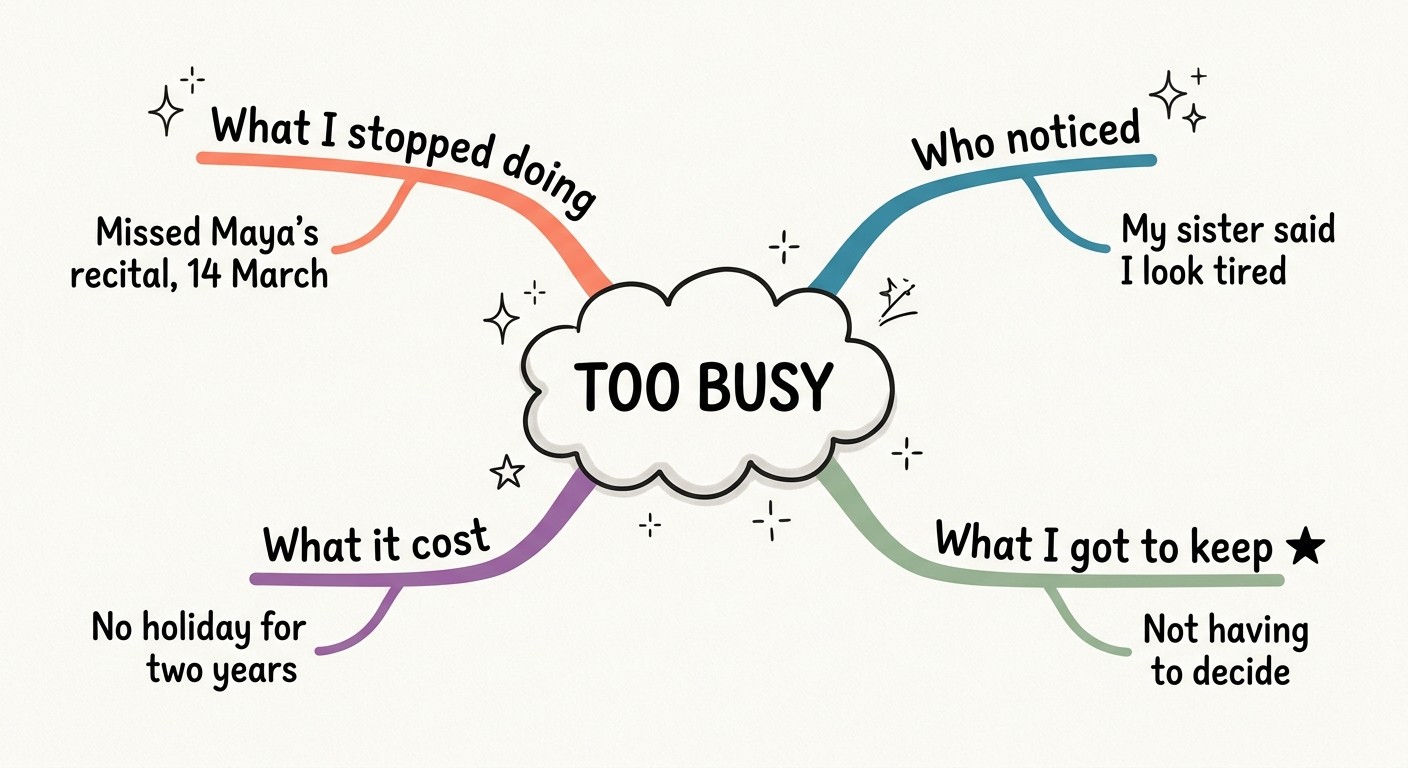
Illustration: AI-generated
That fourth branch is the one I would never leave out. Most patterns we want to change are giving us something. Until that is on the page, we are arguing with only half the picture.
A map is private by default. You choose what to share, and with whom. In my experience people are more honest on paper that nobody will collect.
Going round the same subject again?
Try it tonight: one phrase, four branches, facts only, one star. If you would like company while you look at the map, let’s meet in a clarity session.
This story is fictional.